The museum's best-of

The paintings of the Musée d'Orsay: 20 masterpieces, floor by floor

4,500 works on display, 3 floors, one visit: you have to choose. Here are the twenty paintings that justify the ticket on their own, precisely located, with what you need to know in front of each — from the scandal of Olympia to the fury of Van Gogh.

Independent guide site — learn more
Works on display
≈ 4,500 (78,000 in the collection)
Period covered
1848 – 1914
Best-of
2.5 h for the 20 majors
Access
All included in the ticket

Available tickets & tours

Compare entry tickets, guided tours and combo deals offered by Tiqets, an authorized reseller — free cancellation on most options.

Ground floor: the founding scandals

Level 0 tells the story of painting before Impressionism — triumphant academicism and the first realist knife-thrusts.

  • Thomas Couture, The Romans of the Decadence (1847) — the academic machine par excellence, 4.7 m × 7.7 m of moralizing orgy. Young Manet was his student… before overturning everything.
  • Gustave Courbet, A Burial at Ornans (1849–1850) — peasants painted at the scale of a royal coronation: realism as political provocation.
  • Gustave Courbet, The Origin of the World (1866) — still the most talked-about painting in the museum; a small dedicated room, forbidden to absolutely no one (no restrictions, but consider yourself warned).
  • Jean-François Millet, The Angelus and The Gleaners (1857–1859) — the peasant dignity that obsessed Van Gogh to the point of copying the figures.
  • Édouard Manet, Olympia (1863) — the nude that sent Paris into a fury: a frontal gaze, a black cat, and modern painting begins.
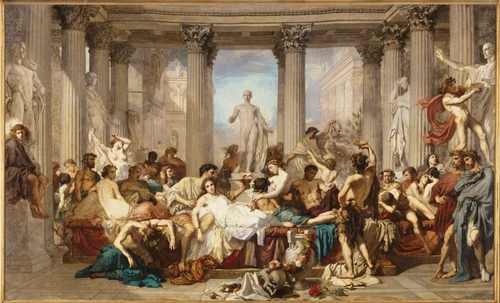
The Romans of the Decadence by Thomas Couture (1847), Musée d'Orsay
Couture, The Romans of the Decadence — the academic giant that opens the visit.

Fifth floor: the Impressionist sanctuary

The gallery running along the Seine beneath the glass roof holds the world's densest concentration of Impressionist masterpieces. The unmissables, west to east:

  • Édouard Manet, Luncheon on the Grass (1863) — the scandal of the Salon des Refusés: one nude woman, two clothed gentlemen, no mythological alibi.
  • Claude Monet — Poppies, the Gare Saint-Lazare, the Rouen Cathedrals: detailed trail here.
  • Pierre-Auguste Renoir, Bal du moulin de la Galette (1876)our Renoir page tells the story of the canvas and its Montmartre garden.
  • Edgar Degas, The Dance Class (1874) and In a Café (L'Absinthe, 1876) — the cruelest and truest eye of the group; don't miss the Little Fourteen-Year-Old Dancer, in sculpture.
  • Gustave Caillebotte, The Floor Scrapers (1875) — torsos at work, rejected by the Salon as a "vulgar subject", adored today.
  • Berthe Morisot, The Cradle (1872) — the first woman Impressionist, too often skipped by hurried groups.
  • Paul Cézanne, The Card Players and Apples and Oranges — the bridge between Impressionism and the Cubism to come.
  • James Whistler, Portrait of the Artist's Mother (1871) — "Whistler's Mother", lent by America to his adopted France.

Middle level: Van Gogh, Gauguin and the world after

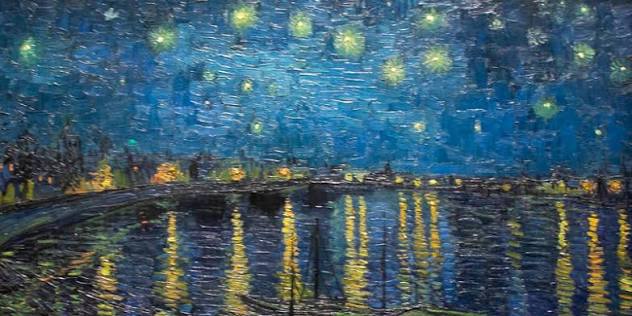
Starry Night Over the Rhône by Vincent van Gogh, Musée d'Orsay
Van Gogh, Starry Night Over the Rhône (1888) — Françoise Cachin gallery.
  • Vincent van Gogh — the 1889 self-portrait, Starry Night Over the Rhône, The Church at Auvers: the whole room, decoded.
  • Paul Gauguin, Tahitian Women (1891) — flat planes of color that would inspire Matisse.
  • Georges Seurat and Paul Signac — Pointillism under the microscope: The Circus, unfinished at Seurat's death, aged 31.
  • Henri de Toulouse-Lautrec — Montmartre nightlife without indulgence or moralizing.
  • Henri Rousseau, The Snake Charmer (1907) — the dreamed-up jungle of a toll-office clerk who never left France.

To see everything without burning out, follow our anti-crowd order: fifth floor at opening, middle level around 11 AM, ground floor in the afternoon — practical details in the skip-the-line guide and the opening hours.

Three tips in front of the paintings

Step back. Impressionism reads from three meters away: the brushstrokes melt together and the light appears. The nose-to-canvas reflex is the surest way to see nothing at all.
Photograph without flash — allowed everywhere in the permanent collections. Selfie sticks are banned.
Choose 20 works, not 200. Museum fatigue strikes after about 90 minutes: better 20 memorable encounters than 200 glances. That's exactly what this list is for.

Ready for Orsay?

Since March 2026, booking a timed entry slot is mandatory. Reserve your entry in advance and simply show up with your mobile ticket.

Book my tickets

Frequently asked questions

What are the most famous paintings at the Musée d'Orsay?

Manet's Olympia and Luncheon on the Grass, Renoir's Bal du moulin de la Galette, Monet's Poppies and Gare Saint-Lazare, Van Gogh's self-portrait, Courbet's The Origin of the World, Millet's The Angelus and Degas's Little Dancer.

How many works does the Musée d'Orsay hold?

The collections exceed 78,000 works, of which around 4,500 are on display: paintings, sculptures, photographs, decorative arts and architecture, covering the period 1848–1914.

Is the Mona Lisa at the Musée d'Orsay?

No, the Mona Lisa is at the Louvre, across the Seine. Orsay picks up chronologically where the Louvre leaves off: art from 1848 to 1914, with Impressionism front and center.

Can you photograph the paintings?

Yes, without flash, for private use, in the permanent collections. Selfie sticks are banned, and some temporary exhibitions may restrict photography.

Where is The Origin of the World displayed?

On the ground floor, in the Courbet rooms. The painting is shown with no age restriction, among the other canvases by the master of Ornans.

Which floor should you prioritize if you only have an hour?

The fifth: the Impressionist gallery concentrates Manet, Monet, Renoir, Degas and Cézanne. Head straight up at opening time, then come back down via the Van Gogh gallery if time allows.