Nobody painted happiness like Renoir. Orsay lines up his best-loved canvases — the Bal du moulin de la Galette above all, one of the most famous paintings in the world. A guide to the rooms, the details not to miss, and the quiet hours.
Compare entry tickets, guided tours and combo deals offered by Tiqets, an authorized reseller — free cancellation on most options.
| Work | Year | Look closely at |
|---|---|---|
| Bal du moulin de la Galette | 1876 | The light falling in dapples through the acacias — every face is a friend of Renoir's, Montmartre in full |
| The Swing (La Balançoire) | 1876 | Painted the same summer, in the same garden on Rue Cortot; the same patches of sunlight, turned vertical |
| Dance in the City / Dance in the Country | 1883 | The inseparable pair: Suzanne Valadon icy in the city, Aline Charigot (the future Mme Renoir) laughing in the country |
| Young Girls at the Piano | 1892 | The French state's first commission from Renoir — official consecration for the Salon outcast |
| Gabrielle with a Rose | 1911 | The late "pearly" period: hands deformed by arthritis, the brush strapped to his wrist |
| Torso in Sunlight (Torse, effet de soleil) | c. 1876 | The nude that made the critics howl — "flesh in decomposition" — look for the green and pink reflections |
The Bal du moulin de la Galette is as much a manifesto as a party. In 1876, painting a working-class Montmartre dance hall in history-painting format (1.31 m × 1.75 m) meant giving ordinary Sunday crowds the space reserved for gods and battles. The critics choked; Gustave Caillebotte, painter and patron, bought the canvas — and it was his bequest that brought it into the national collections in 1894.
Look at the ground: there isn't a single gray shadow. The violet and blue dapples dancing across the jackets and the gravel are Renoir's technical signature — light sifted through the foliage, rendered in touches of pure color. From ten centimeters away, it's chaos; from three meters, it's a perfect Sunday afternoon.
Round out the visit with Monet, his companion in poverty and open-air painting through the 1870s, and the museum's 20 masterpieces.
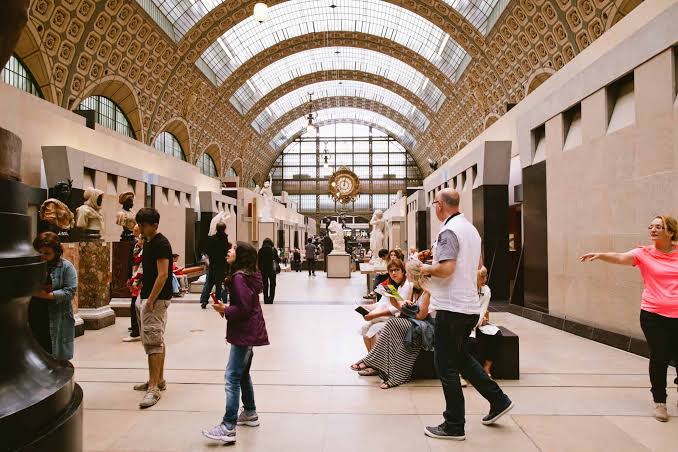
The Renoirs are concentrated on the fifth floor, in the Impressionist gallery, a few meters from the Monets — one ticket, one floor, one well-spent hour. The order that works:
Tickets and time slots: it's all in our prices guide; those in a hurry should read how to cut the lines.
Since March 2026, booking a timed entry slot is mandatory. Reserve your entry in advance and simply show up with your mobile ticket.
On the fifth floor, in the Impressionist gallery. It's one of the most crowded canvases in the museum: aim for opening time or Thursday evening to approach it comfortably.
Several dozen paintings, plus drawings and pastels shown in rotation. The major canvases listed in this guide are on near-permanent display, barring an exceptional loan.
Yes, at the top of Rue Lepic in Montmartre — the Blute-Fin windmill is still there, and a restaurant carries the dance hall's name. Allow 30 minutes by métro from Orsay: the pilgrimage works well that same afternoon.
The museum regularly devotes temporary exhibitions to Renoir and his circle; they are included in the entry ticket, subject to capacity. Check the booking widget at the top of the page for current offers.
They're on the same floor, so the question settles itself: start with whichever draws you most while the rooms are still empty — the other is fifteen minutes behind. Our two detailed trails: Monet and this page.