"Saint Lazare Musée d'Orsay" is really two questions in one: where to see Monet's steam-filled canvas, and how to get from the actual station to the museum. This guide answers both — Impressionism's railway story and the fastest way there.
Compare entry tickets, guided tours and combo deals offered by Tiqets, an authorized reseller — free cancellation on most options.
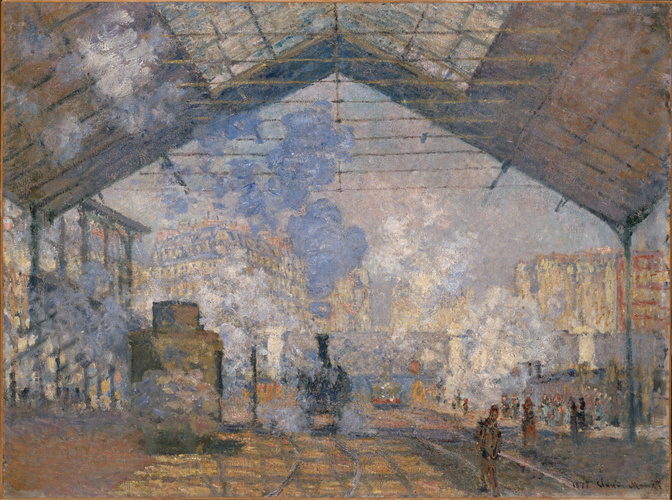
In January 1877, Monet got permission to set up his easel inside Gare Saint-Lazare — the largest, most modern station in Paris, and the one serving Argenteuil, where he lived. Within three months he produced a series of a dozen canvases: the first time a painter treated a railway station the way Rouen would later treat its cathedrals.
The Orsay version shows the covered train shed, a black locomotive at the center, and above all the real subject: steam. Blue beneath the glass roof, white in the light, it dissolves iron and glass into pure atmosphere. The critics sneered — "Monsieur Monet paints smoke"; that was precisely the point.
Eight canvases from the series were shown at the third Impressionist exhibition (April 1877). Today they are scattered between Orsay, the Fogg Museum, the Art Institute of Chicago and private collections — Orsay's is the most famous.
Arriving by train from Normandy or the western suburbs? Here are the real routes, tested on foot.
| Option | Time | How |
|---|---|---|
| Métro line 12 (the simplest) | ≈ 15 min | Toward Mairie d'Issy, 4 stops to Solférino, then a 5-min walk down Rue de Solférino toward the Seine |
| On foot (the prettiest) | ≈ 20–25 min | Rue Tronchet → Madeleine → Rue Royale → Place de la Concorde → Pont de la Concorde → Quai Anatole-France: Paris in a nutshell |
| Bus 94 then a walk | ≈ 20 min | Toward Sèvres-Babylone, Solférino stop; handy with light luggage, slower at rush hour |
Saint-Lazare was no random backdrop: it was the Impressionists' station. Its lines served all their open-air studios — Argenteuil (Monet), Chatou (Renoir), Pontoise (Pissarro), Vétheuil, Giverny. The train meant access to the outdoors, and therefore to the new painting: easel under one arm, 30 minutes in a carriage, and the Seine replaced the studio.
Manet painted The Railway (1873, Washington) in front of the same station; Caillebotte, the Pont de l'Europe that spans it. In 1877, when Monet exhibited his stations, the subject said one simple thing: modern life — speed, steam, crowds — deserves great painting as much as the gods do.
At the museum, keep the theme going: the Monet room on the fifth floor, then the Opéra model and the architecture rooms on the ground floor to understand Haussmann's Paris, the city those trains fed. And to prepare your entry: prices and fast access.
Since March 2026, booking a timed entry slot is mandatory. Reserve your entry in advance and simply show up with your mobile ticket.
On the fifth floor of the Musée d'Orsay, in the Impressionist gallery, with the other Monets. It occasionally travels on loan: the gallery attendants can tell you whether it's on view on the day of your visit.
A dozen canvases in three months, in early 1877, eight of which were shown at the third Impressionist exhibition the same year. Orsay holds the best-known version.
Métro line 12 from Solférino toward Aubervilliers, 4 stops, about 15 minutes door to door — or a 20–25 minute walk via Concorde and the Madeleine.
Yes, the station has automated lockers. That's the right move: the museum refuses suitcases and large luggage at the cloakroom.
Yes — the train shed has been modernized, but the glass roofs and the Pont de l'Europe are still there. From the suburban-line platforms, the painting's perspective is still recognizable, minus the steam.
Yes: since March 2026, a reserved time slot is mandatory. Book online during the journey — the confirmation lands on your phone within minutes.